Please Donate Click Here
Our WhatsApp contact us to join Click Here
Windfarms, Land & Property. What We’ve Learnt Click Here
Introduction
This page is here to provide the Community with information on the proposed Kilmichael wind farm. Read on or follow links to; The Proposals, How big are the turbines?, The new substation, Who are Regnum?, Who would own the windfarm?, What are the effects on our Community? What happens next?, The lobbying, The Landowners, The planning process, What is an observation?, What about our Property?
Windfarms, Land & Property. What We’ve Learnt
Over a period of four weeks members of the committee have met landowners, representatives from other community groups from around the country and specialist legal professionals. All the people and groups we have met have first-hand and extensive experience in windfarm developments. This report is a truthful summary of the key findings and what we have been told.
In general windfarm developers have been found to be completely unscrupulous. Their attitudes to and levels of cooperation with landowners and the community will change significantly once planning permission has been granted. They will offer money to adjacent landowners to stay quiet and not object, to members of the committee opposing the development to stand down and to anybody and everybody who has any capacity to disrupt their plans.
Many of the local solicitors that landowners use for everyday legal matters do not have the specialist knowledge and experience needed to understand the implications and the detail contained in the options agreements put forward by the windfarm developers. Landowner/farmer option contracts all tend to be the same and are extremely onerous for the landowner. The developer’s primary objective is to maximise profits, gain maximum control over the land now and in the future and maximise the potential to sell the windfarm. The landowners and the communities’ interests are very low on their list of priorities. Key details of the agreements that are commonly misunderstood are;
- Landowners believe they are tied in for 10 years. In reality they could be losing all control over their land for 35 years+
- If the landowners family ever wishes to get planning permission and a mortgage for a site in the future, they will often have to get the developers to give them written permission. The developers are unlikely to agree as this introduces the possibility of a future resident complaining about the windfarm.
- The developers will often hold the fishing, walking & hunting rights over the land for periods of 35 years+ and will not grant any access for these activities.
- If the developer applies for Planning Permission in the future for further development there is little that the landowner can do about this. This also applies if the developer proposes to move a turbine a lot closer to the landowners property than was previously proposed.
- Farmers are led to believe they are going to earn €40,000/annum in income. In reality because of the actual wind turbine output the level of gross income is likely to be nearer to half this amount.
- At the end of the operating life of the turbine it is the farmers responsible for getting the land away from “industrial” back to agricultural use and bearing the significant costs involved.
- The ownership and rights of the windfarm can and do get sold onto a third party. This is likely to be a Chinese investor, with all the associated implications. We understand that Regnums portfolio of renewable projects might already 'up for sale'. If planning permission is granted for Kilmichael, this is likely to suffer a similar fate.
A significant impact on the community that results from the landowners agreeing to host the wind turbines will be that once planning application has been granted the developer will object to any further planning applications within a 3km radius for the next 35 years+. This is to avoid having to deal with any more ‘troublesome neighbours’. This applies equally to applications made by landowners or members of the wider community.
In one case a landowner who had granted temporary access to their land for the construction phase lost all control of their land for the life of the windfarm. The need for access was made permanent due to a condition imposed by An Coimisiún Pleanála.
The subject of house and property values is one that will be argued strongly by the wind farm developers. However, there is strong evidence from the practical experience of those living in windfarm areas that property suffers a significant drop in value.
What are Regnum Proposing?
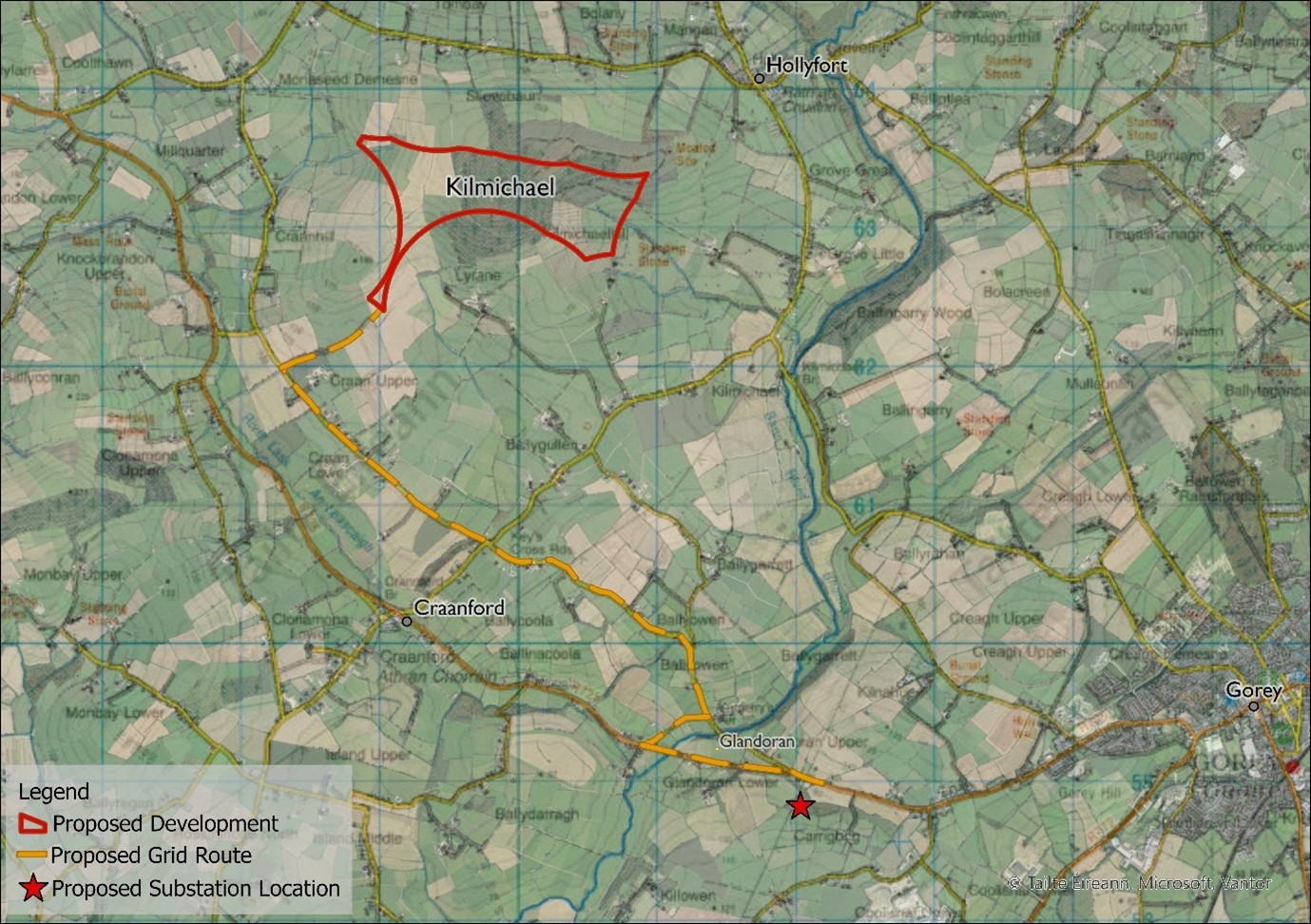
The plans include the construction and installation of 8, 182m high wind turbines with a combined output of 55 MW. The work will include construction of access roadways, construction compound, six kilometers of underground cabling, and a 110kV substation . There will be a new connection to the national grid via existing overhead power lines. The turbines will be spread over the area around the existing communications mast (this is 32m high) in the middle of Craanford, Hollyfort and Monaseed as indicated below. The substation would be located in Glandoran. As the combined output of the turbines is over 50 MW, (even though this area is identified in Wexford County Councils development plan as 'Uplands' and not to be considered for wind farm development) it is classed as 'Strategic Infrastructure' and therefore the company do not have to go for planning permission to WCC, they apply directly to An Bord Pleanála. Their decision is final, there is no appeal. The period for which Regnum will apply for PP is understood to be 35 years. It is not only us and our children who will be living in the shadow of the turbines if this goes ahead, but our childrens children as well. At least three generations will be affected. The turbines are located within and on the edges of the red area indicated below.
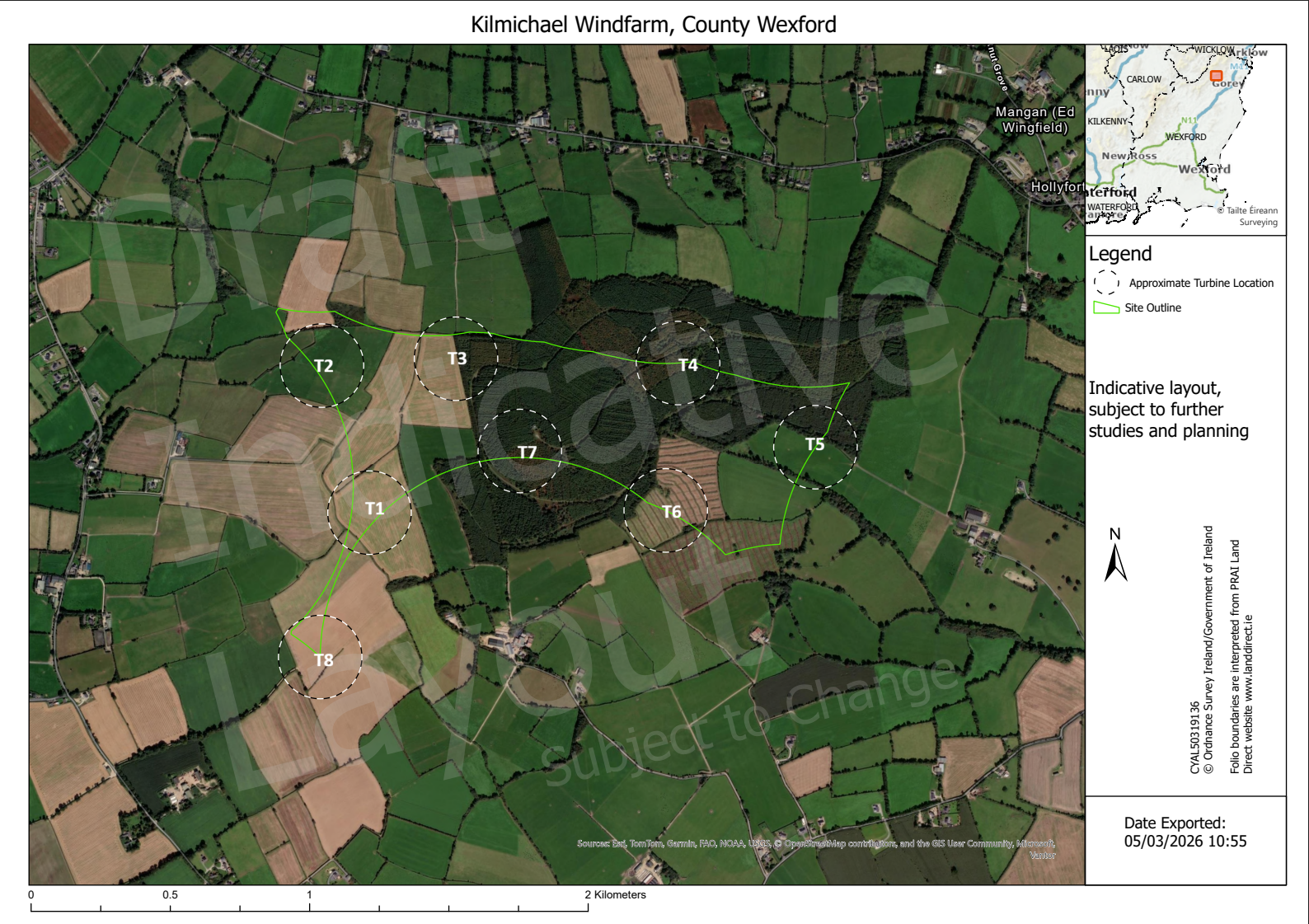
The DRAFT turbine layout below shows actual turbine locations, although these could be changed by Regnum. The closest distance from any turbine to our houses is 4 x 182m = 728m, 4 x the height of the turbine. Some recommendations currently being considered by the government include a minimum allowed distance between a turbine and a house of 7.5 x the height of the turbine which would be 1365m or 1.365 km. Turbines T4 and T7 are located on Coillte land. 6 turbines are located on private land. The landowners have come to an agreement with Regnum to grant permission in return for annual financial payments for the operational life of the wind farm. The landowners who have agreed to allow the turbines on their land are Rusty Doran of Carnew (T1 and T3), Nick Darcy of Mount Nebo (T5), Bob Bailey of Craanhill (T2), John Lancaster of Clonamona Upper (T8), and Clive Cobbe of the Mount (T6). Regnum have also secured the agreement of several more landowners to accommodate site access, the cable and the 110kV substation including Alan Poole of Ballyowen, Gavin Kinch of Carribeg & Ms Stephanie von Schilcher of Carribeg. It is worth noting that we understand that the cable route indicated in the current information provided by Regnum to be inaccurate. We believe that the cable passes through more privately owned land than currently indicated. Regnum have been asked to provide an up to date route map.
How big are the turbines and what would they look like?
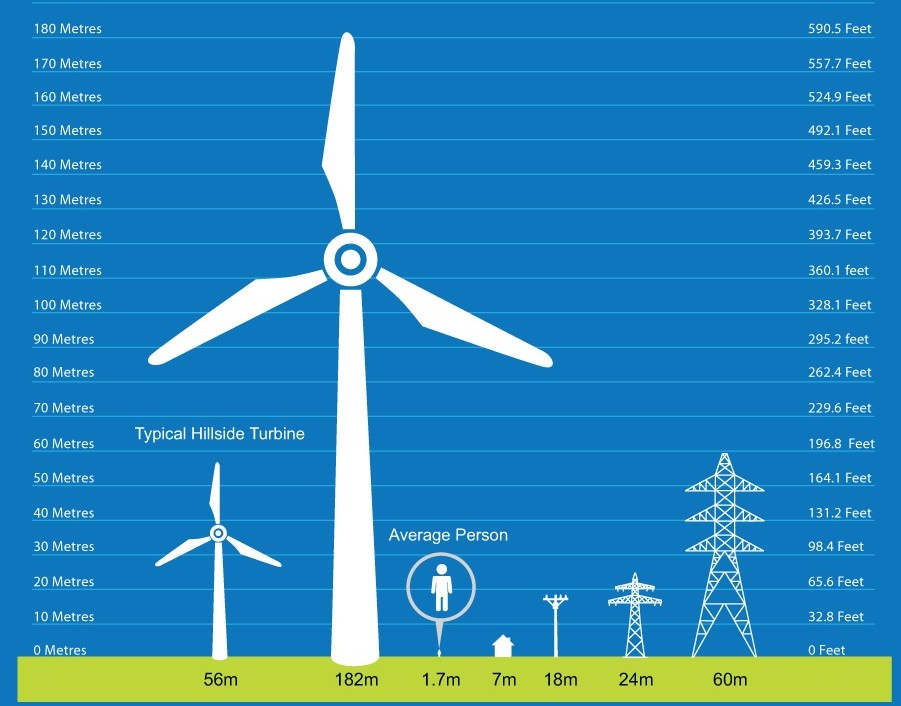
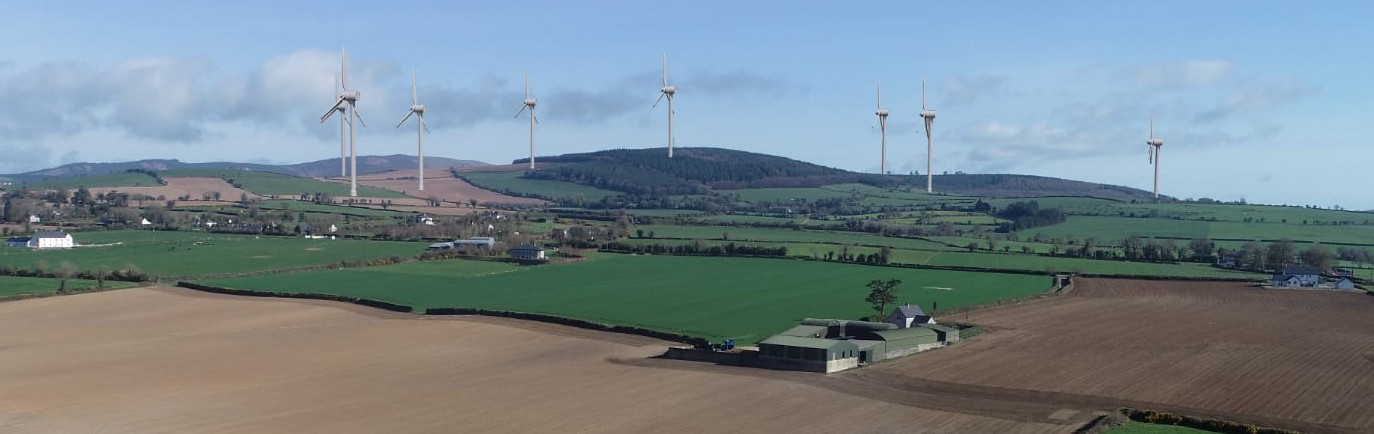
No information has been provided by Regnum as part of the 'Community Engagement' to demonstrate the visual impact of the 182m turbines. To put their size in perspective, they are six times the height of the existing communications mast, 50 m higher than the Croghan turbines and 70 m higher than the turbines on Gibbets Hill (this is the wind farm on your left as you drive from Carnew to Bunclody).
This a video showing the installation of a turbine of the size that Regnum are proposing to put on our hill in the middle of our community. The turbines in the video are being installed in a very remote location in Spain and not close to houses and villages.
Installation of the VESTAS 162 Turbine
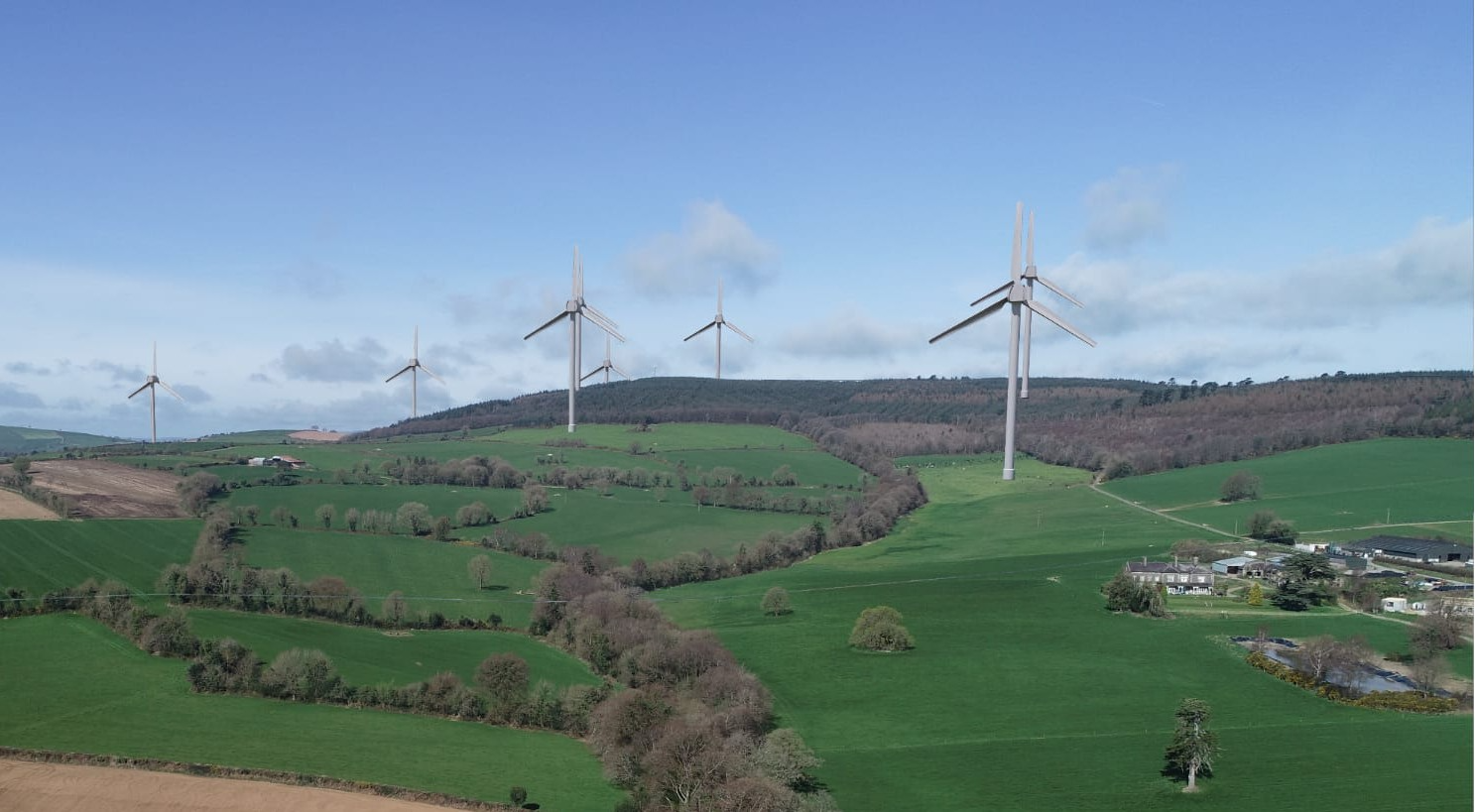
The images below have been generated using drone footage with the wind turbines added to scale, and in the positions indicated by Regnum . The visual impact of these industrial scale machines is significant. The Wexford County Development Plan specifically excludes this area from being considered for Wind Farm development. Unfortunately An Bord Pleanála have the power to grant a planning application which is in direct contravention of a county development plan if it is considered to be in the national interest.
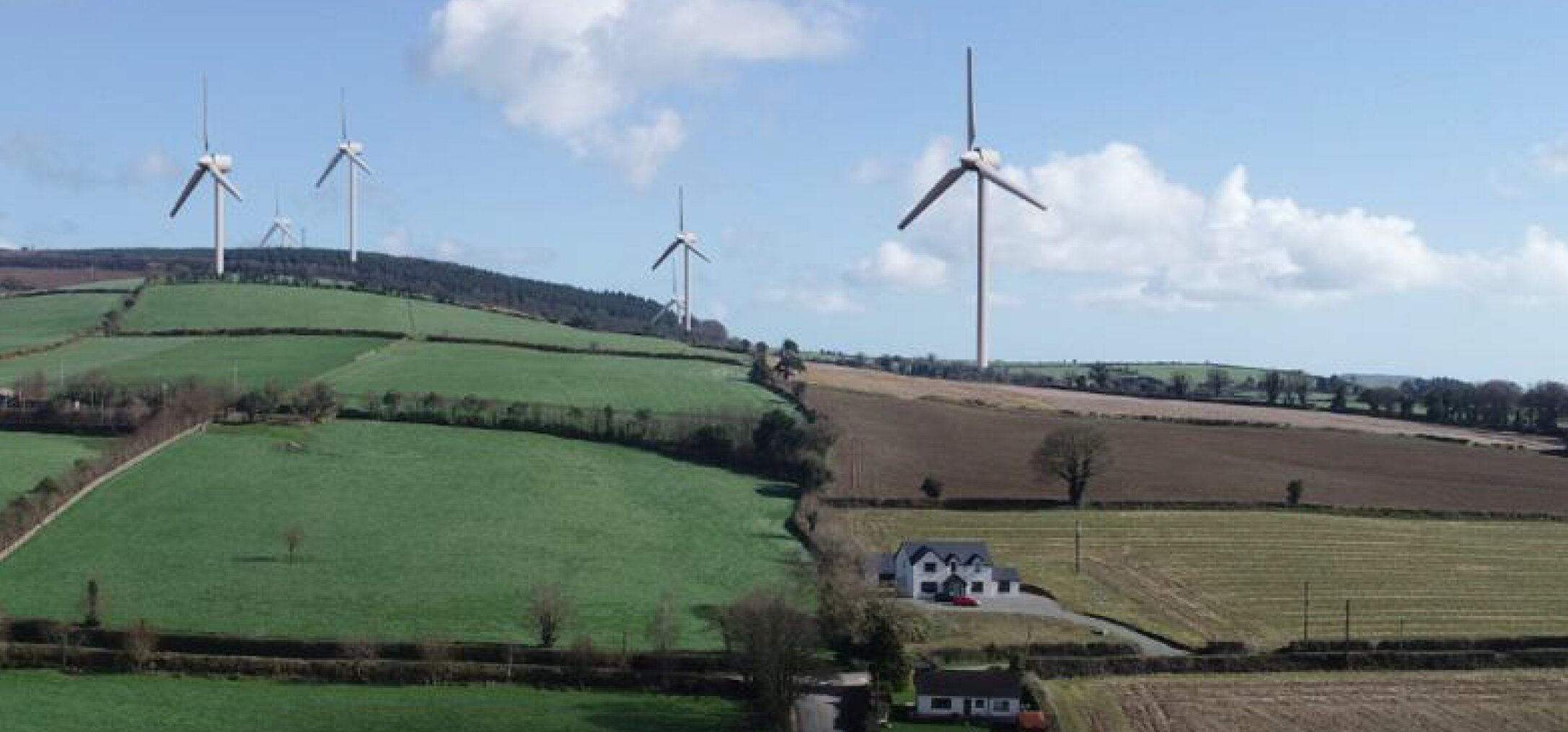
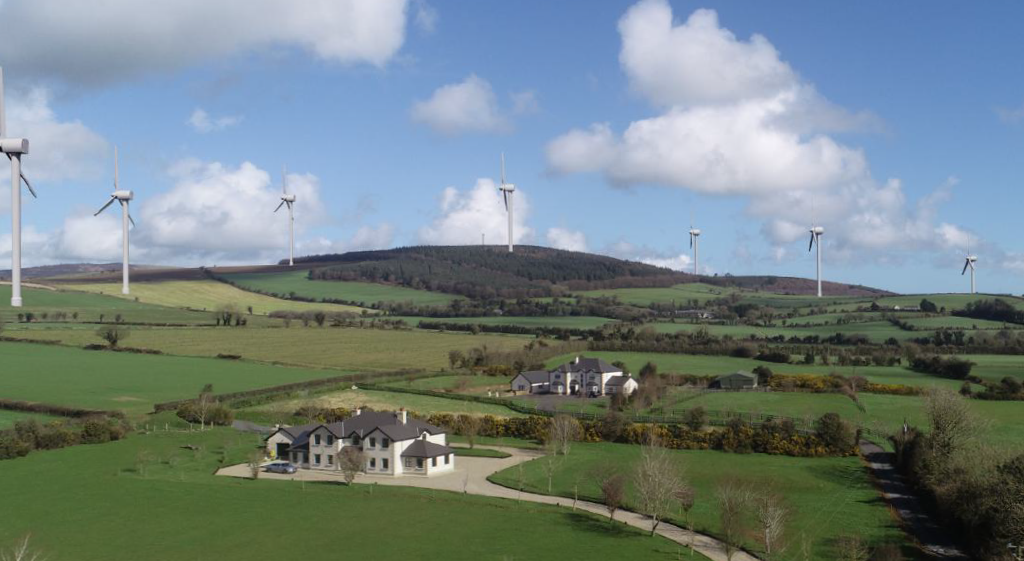
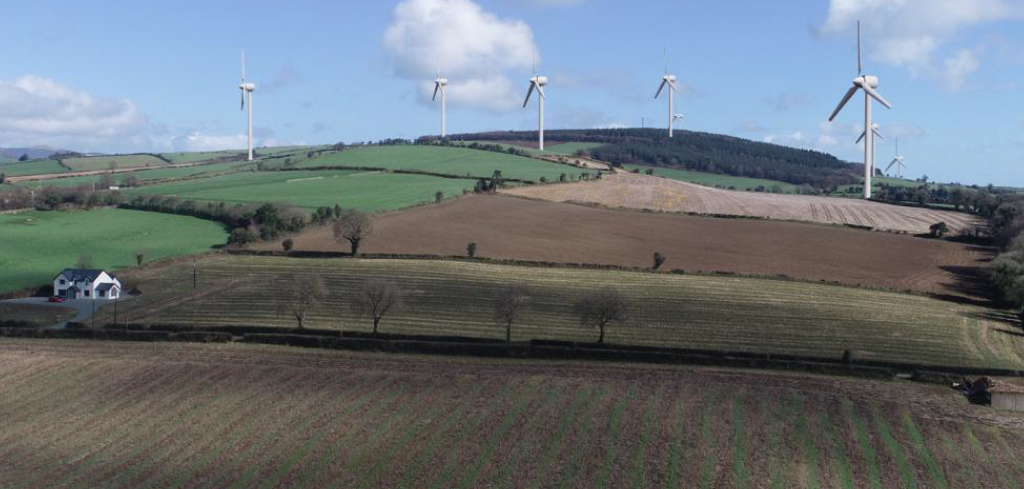
The view from Monaseed Village;
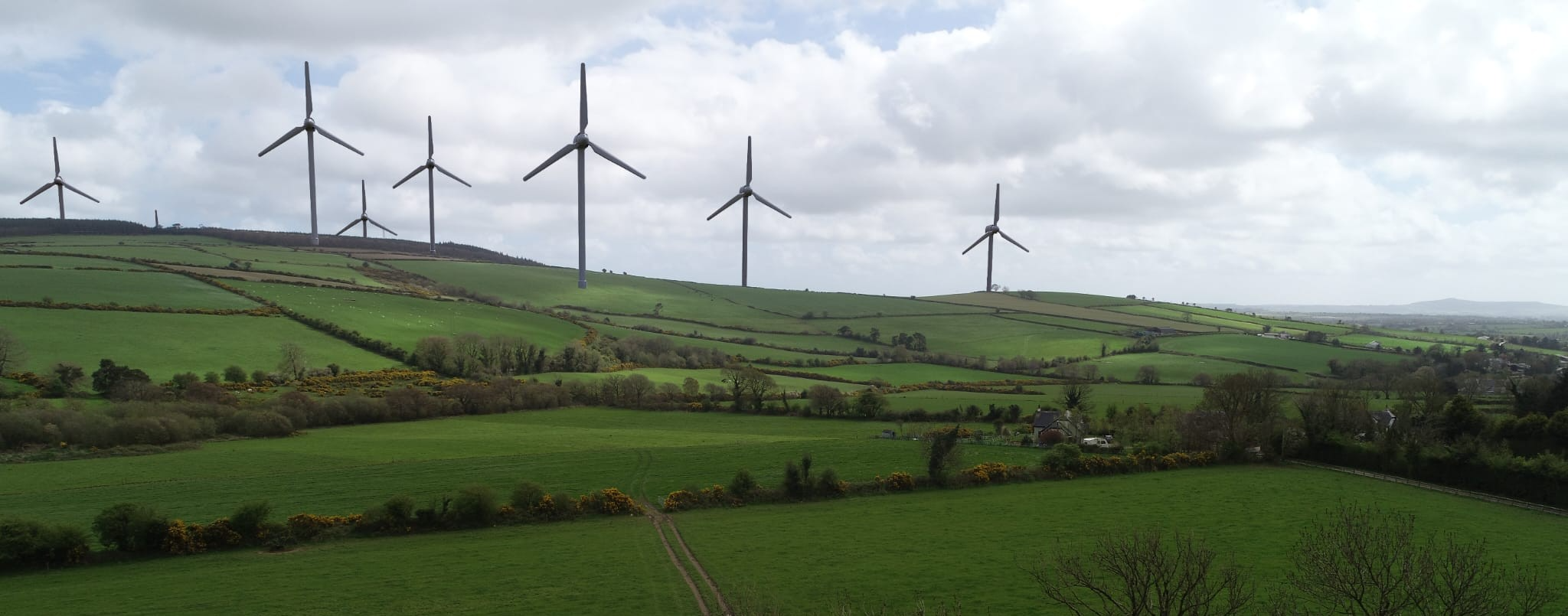
The view from Craanford;
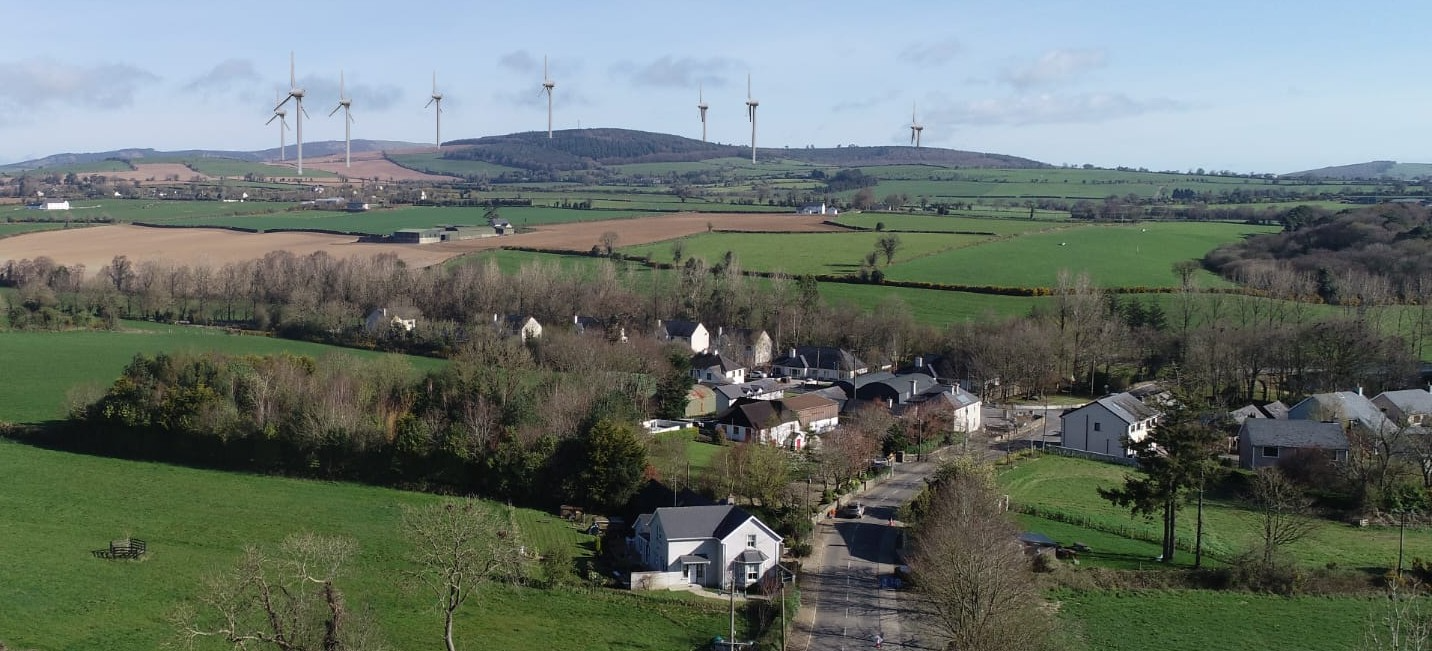
The view from The Carnew Road;
The view showing Mount Saint Benedict in the foreground, Mount Nebo
What would the new substation look like?
Again we have no detailed information from Regnum on the proposed substation. This is an image of the 110 kV substation built for Cushaling wind farm in County Offaly. Cushaling has an output similar to Kilmichael with 9 185m high Vesta turbines. The wind farm was developed by Statkraft.

Who are Regnum Renewables?
Regnum have their registered office in Dublin at 2 Seapoint Avenue, Blackrock, Co Dublin, A94 VY68. Their day to day operations are run from the 3rd Floor at 29/30 Fitzwilliam Square, Dublin 2. The company was incorporated on 29th August 2022 and their company registration number is 724980. The company directors: are listed as Michael O’Sullivan – Director / CEO / Founder, Kevin Daly – Director / COO / Co-Founder, Ciara Bermingham – Director / Chief Commercial Officer. The other staff at Regnum who are involved in the Kilmichael project are Daragh Browne, Project Manager and Barry Brennan, Community Liaison Officer.
Research into the chain of ownership reveals that Lanber Holdings Unlimited Limited – Company Number 81274, formed in 2 March 1981 are owners of Regnum Renewables Ireland Limited, Regnum Holdings Limited and Regnum Renewables Developments Limited, the developer of Kilmichael Wind Farm.
Lanber Holdings, the company at the top of the ownership tree have their registered address at Senan House, Enniscorthy Technology Park. The directors are Samuel Bertram Allen, Maurice Lancelot Allen, Geraldine Fitzgerald and Patrick Joseph Asple (Company Secretary). Lanber Holdings does not have to publicly file financial statements due to it’s “unlimited Limited” status
Who would own the Wind Farm?
Lanber Holdings Unlimited Limited are owners of Regnum Renewables Developments Limited, the developer of Kilmichael Wind Farm. They would presumably be the owners of the wind farm if it goes ahead.We understand that Regnums portfolio of renewable projects might already 'up for sale'. If planning permission is granted for Kilmichael, this is likely to suffer a similar fate.
However, the future ownership of the windfarm could be less certain. There have been recent reports of China's intention to invest heavily in Irish wind energy. Irish Times Article; China wants to import more Irish food and a stake in Irish wind energy In fact in 2016 the Chinese purchased 14 wind farm projects across Ireland for a reported 350m Euro. The China General Nuclear Power Group (CGN) took control of the projects located in the north and south of the country. If this wind farm goes ahead the turbines sitting on the land around us could realistically become the property of China or another direct foreign investor. BBC Article; Chinese firm buys 14 wind farm projects across Ireland
What are the effects on our Community?
These videos highlight the real effects on Ireland's communities of these developments Against The Goliath
The immediate effects of the proposed development that people are already experiencing include;
- The deep anxiety and stress of not knowing and not being clearly informed of what is going on. This was demonstrated by many of the contributions at the first meeting of the community, attended by more than 140 residents.
- Tensions among neighbours and friends. Tensions are developing between the community and the landowners who have given access to Regnum for the turbines, access, cabling and substation.
- Deep Concern. Again the communities deep concerns were expressed by many at the first community meeting about an uncertain future.
Future concerns if the development goes ahead include;
- The disruption from noise, vibration and dirt and the dangers of HGV traffic during construction. After speaking with people in the industry, the estimated number of truck journeys for stone, tarmac, steel, machinery and turbine components is approximately 750-900 per turbine.
- The deepening of tensions and divisions between the community and those who have given access to their land.
- Living with the significant visual impact that the 182m turbines, access roads and 110kV substation will have on such a beautiful rural uplands area
- Noise and vibration during operation of the windfarm over the next 35 years
- The potential for shadow Flicker
- The potential for Infrasound. Professor Ken Mattsson, from Uppsala University, Sweden,“Separating Myth from Fact on Wind Turbine Noise” in Copenhagen
- The potential effects on the health of community members including children who are most vulnerable due to existing medical conditions
- Risks to local wildlife habitats and ecology
- Significant reductions in the value of property
- Limitations on residents family members when applying for planning permission in the future
- Reduced enrollment in Monaseed National School as a result of negative effects on development in the area.
What has already happened and what happens next?
Despite requesting a detailed design, consultation and construction programme with dates, this has not been provided by Regnum. From some research and reviewing the very approximate timelines provided by Regnum in their two information leaflets this is the best estimate of what has and what is about to happen. Public records indicate that lobbying by Regnum and the company employed by them (headed by Ivan Yates) has been ongoing since 2024. It has continued over the last 2+ years. From information from landowners who turned Regnum down, landowner negotiations started around May and April of 2024. It would seem logical to assume that a feasibility study and preliminary design started some time before negotiations with the landowners. The best estimate of the time line of events is summarised below;
In the Past
- Late 2023 to May 2024 Feasibility and preliminary design work by Regnum and their consultants
- January 2024 Ivan Yates appointed by Regnum to lobby on their behalf
- May/April 2024 Negotiations/meetings start with Landowners
- June /July/August 2024. Regnum lobby Gorey/Kilmuckridge councillors at various meetings
- September 2024. Regnum meet with Eddie Taaffe, the CEO of Wexford County Council.
- April 2025 Meeting between Regnum and TD Brian Brennan,
- May 2025 to 2026 Bird & bat surveys.Noise, flood and visual impact assessments take place on site
- June 2025 Regnum makes first contact with a selection of local residents within 1.2 km of the boundary of the planned wind farm with the first information leaflet and one on one meetings.
- July 2025 Regnum met with Deputy Malcolm Byrne in the Leinster House.
- August 2025 Consultation with Wexford County Council in preplanning meetings.
- September 2025 Regnum lobby Gorey/Kilmuckridge councillors
- September 2025 Finalise a turbine layout and a delivery route for turbine blades and access points to the site.
- February 2026 Regnum makes second contact with a selection of local residents within 1.2 km of the boundary of the planned wind farm, issue their second information leaflet and one on one meetings
- March 2026 Preplanning meetings with An Coimisiún Pleanála
- April 2026 Bird & bat surveys continue. Noise and hydrological assessments complete. Visual impact assessments to be completed
- May/June 2026? Compile draft chapters of Environmental Impact Assessment Report (EIAR)
In the future
- September 2026? Planning submission by Regnum to An Coimisiún Pleanála
- 6 week period allowed for the public (Including our Group, Notokilmichaelwindfarm) to lodge ‘observations’ in conjunction with a 10 week period for WCC to submit their observation report
- 18 weeks until An Coimisiún Pleanála publish their decision.
- 18 to 24 months construction period.
- 2027 to 2062 Operation of the windfarm.
Lobbying by Regnum
The company have been conducting a lobbying campaign of our elected public officials for over two years. The details below are taken directly from public record. Lobbying.ie.
January 2024
Regnum retain Ivan Yates to lobby on their behalf in January 2024.
June July and August 2024
Regnum/Ivan Yates met local TD’s & Councillors and public officials in June July and August 2024. The following were involved in these meetings; Donal Kenny, Ashdown Hotel 26/06 Anthony Donoghue, Ashdown Hotel 16/07 Joe Sullivan, Ashdown Hotel 22/07 Fionntán Ó Súilleabháin, Ashdown Hotel 19/08 Darragh McDonald, Ashdown Hotel 19/08 Nicky Boland, Ashdown Hotel 19/08. Mary Farrell, Amber Springs Hotel 26/08 Oliver Walsh, Upton Court Hotel 26/08 Pip Breen, Upton Court Hotel 26/08 Paddy Kavanagh, Paddy's home 26/08. Emails were sent to all 10 councillors after meeting with them to share a copy of information discussed in the meeting on the proposed project. Informal communication (6-10) Texts were sent from Ivan Yates to share contact details and thank the local councillors that were met for their time The purpose of the meeting is recorded as; ‘’To understand how the project would be received, determine who we should meet and how best to engage with the community.’’
September 2024
Kevin Daly (COO), Karen McDermott (Head of Planning), Barry Brennan (Community Liaison Officer) and Ivan Yates (External) met with Eddie Taaffe, the CEO of Wexford County Council at the Council's offices on 18/09/2024 to discuss the proposed project. ‘’The planning process, work carried out to date, overview of the meetings held with local councillors, the obstacles to the project, the benefits of the project and proposed timelines were discussed.’’
April 2025
A meeting was set up by Barry Brennan (Community Liaison Officer with Regnum) with TD Brian Brennan, via calls and texts in early April 2025. Kevin Daly (Regnum), Daragh Browne (Regnum), Barry Brennan (external, CLO) and Ivan Yates (external) met with Brian Brennan in the Ashdown Park Hotel on 14/04/25. ‘’The aim was also to gain insight into how the project may be received locally and within the council, identify key stakeholders to engage with prior to the project launch, and determine the most effective approach for community engagement.’’
June 2025
Daragh Browne (Regnum) issued update emails on 18/06/2025 to: TDs Brian Brennan and Fionntán Ó Súilleabháin and to councillors Darragh McDonald, Joe Sullivan, Anthony Donoghue, Donal Kenny, Oliver Walsh, Nicky Boland, Pip Breen, Craig Doyle, Mary Farrell and Paddy Kavanagh. The updates included the information that was shared with local residents living in the area
July 2025
Kevin Daly (Regnum), Daragh Browne (Regnum) and Ivan Yates (providing advisory services) met with Deputy Malcolm Byrne in the Leinster House on 03/07/25. ‘’This meeting was to introduce Regnum and the proposed development, to understand how the project would be received, determine who should be met and how best to engage with the local community.’’
September 2025
On 16th September 2025, Regnum Renewables, with Ivan Yates on behalf of Regnum and Barry Brennan the community liaison officer for the project, met with Donal Kenny Councillor (Wexford County Council) Anthony Donohoe Councillor (Wexford County Council) Joe Sullivan Councillor (Wexford County Council) Craig Doyle Councillor (Wexford County Council) Darragh McDonald Councillor (Wexford County Council) Mary Farrell Councillor (Wexford County Council) Nicky Boland Councillor (Wexford County Council) Pip Breen Councillor (Wexford County Council) The meeting was for Regnum Renewables to ‘’provide an update on the proposed Kilmichael Wind Farm application and timelines, as well as feedback from the initial round of community engagement that had taken place.’’
The Landowners
As the community have become aware of the details, we have been shocked by the extent and potential impacts of Regnum's proposed development. It is possible that some of the landowners have found themselves in a similar position. The landowners who have agreed to allow the turbines on their land are Rusty Doran of Carnew (2 turbines), Nick Darcy of Mount Nebo (1 turbine), Bob Bailey of Craanhill (1 turbine), John Lancaster of Clonamona Upper (1 turbine), and Clive Cobbe of the Mount (1 turbine) and Coillte (2 turbines). Regnum have also secured the agreement of several more landowners to accommodate site access, the cable and the 110kV substation including Alan Poole of Ballyowen, Gavin Kinch of Carribeg & Ms Stephanie von Schilcher of Carribeg.
It is likely that the landowners have been under contract with Regnum since May/April 2024. Research indicates that when a wind farm developer approaches a landowner they will typically request a signature for an “option” to grant them access to land for conducting site assessments related to surveying and planning. It is possible that as part of this option the landowners have agreed not to talk to the community about their agreement with Regnum.
By signing the option agreement, the landowner also agrees to enter into a lease agreement with the developer once certain conditions have been met, such as obtaining planning permission, grid connection, and finance.
In exchange for signing the agreement with the developer, the landowner will usually receive an upfront non-refundable payment of around €3,000 to €5,000, along with additional annual payments for the duration of the option agreement, which is generally between three and five years.
If the developer secures planning permission, the landowner is typically promised between €40,000 and €50,000 per annum per turbine for the duration of the operation of the windfarm from the developer. Typically this payment can be linked to the size and output of the turbines accommodated and will be index linked. However, in reality the returns can realistically be half this. Of course this income is also subject to income tax so the reality will probably be significantly less than the top figure of €50,000.
A farmer needs to be aware of the potential taxation issues associated with renewable developments. For instance, income tax will be payable on the rent received from the lease. If the rent pushes the farmer into a higher tax band, they may be subject to just shy of 50% income tax, which is treated separately from their farm income. Farmers must also understand the potential impact of entering into a wind lease on gift or inheritance tax. It is worth noting that land occupied by a wind turbine is generally not considered an agricultural asset, which may prevent the farmer from qualifying for agricultural relief if more than 80% of their assets are deemed non-agricultural at the time of transfer or assent.
Future planning applications by the landowners and their families could be adversely effected by the turbines, access roads and substation works that they have allowed on their land.
How does the Planning Process Work?
The planning process is quite complex but we have tried to summarise the key points below. More information is available at An Coimisiún Pleanála
Strategic Infrastructure Development
A wind farm becomes a Strategic Infrastructure Development (SID) project when it exceeds 50 megawatts (MW) in total output or consists of more than 25 turbines, requiring direct application to An Bord Pleanála (now An Coimisiún Pleanála) rather than local councils. These projects are considered crucial for 'national strategic goals'. Since 2007, planning applications for proposed strategic infrastructure development are not submitted to the local planning authority but instead they are submitted to An Coimisiún Pleanála for a decision. There are no appeals on An Coimisiún Pleanála’s decision.
The Steps involved
The process is:
1. Pre-application consultations. A prospective applicant for permission requests pre-application consultations with An Coimisiún Pleanála (ACP) An Coimisiún Pleanála, Pre-applications consultations
2. Scoping. A prospective applicant requests the Commission to 'scope' the EIAR for the project. This is asking ACP for guidance as to the scope of the Environmental Impact Assessment Report. It is likely that in the case of a windfarm the scope is already well defined. An Coimisiún Pleanála, Scoping
As far as we know this is where we are now, March 2026, Regnum indicate that their application will be lodged in 'Autumn 2026'.
3. Public Notices Applicant puts notices in at least one newspaper and erects site notices. Application must be submitted within 2 weeks of this date.
4. Application. The applicant submits an application for planning permission ACP. An Coimisiún Pleanála, Applications
5. Public Consultation Period. The public (thats us) have a period of six weeks to submit 'observations' on Regnum's planning application. 'Observations' can be made by groups or individuals and there is more information on these below. The local county council are required to submit their own observation on the application.
6. Boards Decision. After an 18 week period APC will decide to grant permission, grant permission with conditions or refuse permission.
There are no appeals allowed to the Boards decision The decision can be challenged through the High Court and Supreme Court.
What is an Observation?
Anybody individual or group can make an 'Observation'. It is where you submit written comments to An Coimisiún Pleanála on a Strategic Infrastructure Development application. When you give your comments, you are said to be making an observation. The details of the application will be made available online By Regnum with hard copies at An Coimisiún Pleanála's office and local planning authority's office. More information on 'Observations' and how to make them are included here; An Coimisiún Pleanála, Observations and here; Citizens information
What role does WCC play in the planning process?
The Planning and Development Act 2000 sets out the requirements for the SID processes. In section 37E it states the following with respect to the Councils involvement with SID applications. In essence WCC have to make their own observation with reference to the WCC Development Plan.
'The planning authority for the area in which the proposed development would be situated shall, within 10 weeks from the making of the application to the Board prepare and submit to the Board a report setting out the views of the authority on the effects of the proposed development on the environment and the proper planning and sustainable development of the area of the authority...'
The chief executive of a planning authority shall, before submitting any report in relation to a proposed development to the Board, submit the report to the members of the authority and seek the views of the members on the proposed development.
The members of the planning authority may, by resolution, decide to attach recommendations specified in the resolution to the report of the authority; where the members so decide those recommendations (together with the meetings administrator’s record) shall be attached to the report submitted to the Board''
WCC, although not the primary authority reviewing and ruling on the application by Regnum, still have a significant role to play and we need to ensure that their observation takes good account of the issues put forward by the local community. We can do this by representation to our local TD's and councillors and by representation to WCC directly. The contact details of our local councillors and TD's can be found here
Whats in the WCC Development Plan 2022-28 about onshore wind energy?
The Wexford County Development Plan 2022-2028 sets out the policies and objectives for the development of the County over the plan period. The section on their Wind Enrgy Strategy can be accessed here
The document contains the councils strategy on all types of renewables. It sets out areas in the County which it considers are suitable for future wind farm developments and areas where wind energy development should normally be considered. It does this through allocating each area within the County a 'Landscape Character Unit'. Four different landscape character units are identified as 'Uplands', 'Lowlands', 'River Valleys' and 'Coastal'. The landscape character units are used as a baseline to assess capacity for areas to accommodate wind farm development and the scale of wind farm development that may be acceptable.
The area of Kilmichael that Regnum have chosen to develop this wind farm has been allocated as an 'Uplands' area. As such, according to the WCC development plan the area has 'Limited capacity to absorb further wind farm development' and is 'No longer suitable –located in the Not Normally Permissible area.'
Despite this classification An Coimisiún Pleanála has the right to grant permission in contravention of the development plan if the project is considered to be of national interest.
Our Local Heritage
There are several sites in the vicinity of the proposed windfarm that are of great importance ot our local history and heritage and must be protected.
Our Property
Property Values
The wind energy companies will cite many research projects which say that wind farms have little or no statistically significant effects on property prices. This research has been conducted in the UK, Europe and America. However, the turbines proposed for this development are a new breed of very large machines, not used in the wind farms included in these studies. There is also not enough distinction between the potential effects close to and at increasing distances from the turbines.
It is common sense that many people will not want to move into an area dominated by 182m turbines. They will not want to be in the vicinity of 110kV substation, whether there are proven effects on health or not. This has to effect the value of our property now and in the future for our children.
There is one study that we can refer to that indicate a negative effect that wind farm developments have on house prices. This is a 2023 University of Galway working paper on ‘Wind Turbines and House Prices along the West of Ireland’ – produced by the Centre for Economic Research on Inclusivity and Sustainability (CERIS). The general conclusion is that turbines can incur a discount on nearby properties of -14.7%.
Future Planning Applications
What effect will the current development and the adoption of more strict setback distances in the revised government Wind Energy Guidelines have on future planning applications by members of the community?
What have our local politicians been doing about it?
Hopefully we will have some material to include here in due course.